
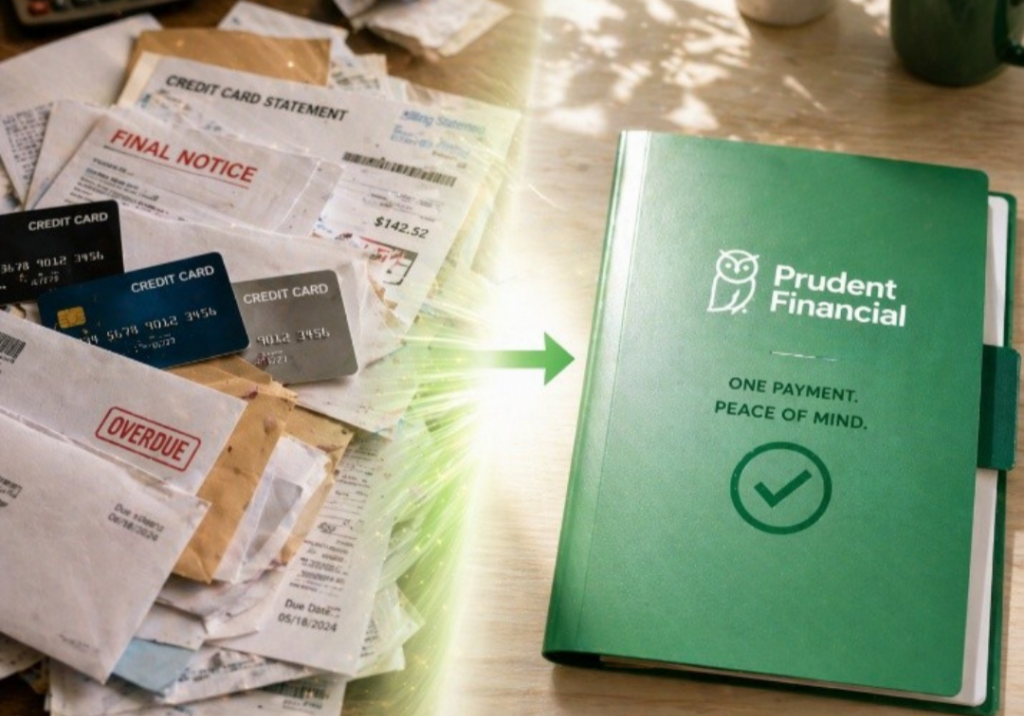
There is a point in many homeowners’ financial journeys where everything appears to be functioning on the surface, yet nothing is truly improving beneath it. Payments are being made on time, accounts remain open, and obligations are technically being met, but the overall financial position feels unchanged month after month, with balances barely moving and stress quietly building in the background. This is the reality for many individuals managing multiple high-interest debts, particularly when those debts are structured in a way that prioritizes interest over meaningful principal reduction.
To properly understand how a private mortgage debt consolidation can change this trajectory, it is helpful to walk through a realistic example of a $30,000 debt scenario that reflects what many homeowners experience today.
In this case, the total debt is not concentrated in one place, but rather spread across several financial products that each come with their own payment structures and limitations.
- A $5,000 personal loan carries a monthly payment of $250
- A $1,000 payday loan requires approximately $200 every two weeks, creating a continuous drain on cash flow.
- In addition to this, three credit cards total $12,000 in balances, with combined minimum payments of $400 that largely go toward interest rather than reducing the principal.
- Finally, a $12,000 line of credit adds another $200 per month
- Bringing the total monthly obligation to approximately $1,050.
While none of these individual debts appear overwhelming in isolation, their combined effect creates a situation where the borrower is committing a significant portion of their income toward repayment without achieving meaningful progress. This is largely due to the structure of these financial products, as credit cards and lines of credit are designed to keep payments low while extending repayment over long periods of time, and payday loans often create cycles that are difficult to exit once entered.
The result is a financial position where consistency exists, but progress does not, and this is precisely where consolidation into a second mortgage begins to present a compelling alternative. Many homeowners begin exploring structured options such as mortgage loans once they realize that unsecured debt is not creating forward movement.
By consolidating the full $30,000 into a private second mortgage at an interest rate of approximately 13 percent, the structure of the debt changes entirely. Instead of juggling multiple payments with varying due dates and fluctuating balances, the borrower transitions into a single, amortized payment that is designed to reduce both principal and interest over time.
At a five-year amortization, the monthly payment would be approximately $683, which already represents a meaningful reduction from the original $1,050. Extending the amortization to ten years reduces the payment further to around $448, while a fifteen-year structure brings the payment down to approximately $380. This creates a monthly savings range of roughly $400 to $600, depending on the selected amortization period, and immediately improves the borrower’s cash flow in a way that is both measurable and sustainable.
The significance of this shift goes beyond the numbers themselves, as the real advantage lies in the structure of the repayment. Unlike revolving credit products that allow balances to linger indefinitely, an amortized mortgage creates a defined path toward becoming debt-free, with each payment contributing to the reduction of the total balance. This introduces a sense of direction and progress that is often missing in fragmented debt situations, where borrowers can feel as though they are continuously paying without moving forward.
Improved cash flow is often the first noticeable benefit, and it tends to have a ripple effect across other aspects of financial stability. When an individual frees up several hundred dollars per month, it becomes easier to manage day-to-day expenses, avoid additional borrowing, and begin building a financial cushion. This reduction in pressure can also lead to better decision-making, as financial choices are no longer being made under constant stress or urgency.
Another important outcome of consolidation is its impact on credit rebuilding. High utilization on credit cards, frequent reliance on payday loans, and inconsistent payment structures all contribute negatively to a borrower’s credit profile. By consolidating these debts into a single structured loan that reports to credit bureaus, the borrower begins to establish a pattern of consistent repayment, which is one of the most important factors in improving credit over time. As balances are paid down and utilization decreases, the overall credit profile becomes stronger and more stable.
Beyond the financial and credit-related advantages, there is also a meaningful psychological benefit that comes from simplifying multiple obligations into one clear, manageable payment. Managing several debts simultaneously requires ongoing attention and coordination, and it increases the likelihood of missed payments or errors. When everything is consolidated into a single payment with a predictable schedule, the process becomes more straightforward and easier to maintain, which supports long-term success.
It is also worth noting that private mortgage solutions often retain a level of flexibility that allows borrowers to adapt as their circumstances improve. Many second mortgages can be paid off early or restructured at renewal, which provides an opportunity to transition into lower-cost financing in the future or accelerate repayment when additional income becomes available. This ensures that consolidation is not a static solution, but rather a step within a broader financial strategy, particularly when structured through experienced providers of mortgage loans who understand how to align repayment with long-term outcomes.
The role of a private lender becomes particularly important in making this type of solution accessible, as traditional financial institutions often rely heavily on income verification and credit scores when evaluating applications. In contrast, private lenders focus primarily on the equity within the property, which allows them to provide solutions to borrowers who may not meet conventional lending criteria but still have a strong asset base. This approach not only broadens access to financing, but also significantly reduces the time required to reach a decision, with many approvals and fundings occurring within days rather than weeks.
For homeowners who find themselves in a position where multiple debts are creating pressure without progress, exploring private mortgage debt consolidation options can be the turning point that transforms their financial trajectory. It allows them to move away from fragmented obligations and toward a structured plan that delivers clarity, reduced payments, and a realistic path forward. If you would like to discuss a debt consolidation using home equity, visit www.prudentfinancial.net.